


Revenue Cycle Management is the financial backbone of every dental practice. It encompasses every step from patient scheduling and insurance verification through claim submission, payment collection, and reconciliation. Yet for most practices, the revenue cycle is fragmented across disconnected tools, manual workflows, and multiple vendor relationships—creating inefficiency, revenue leakage, and administrative burden that directly impacts profitability.
The modern dental organization demands more. As the industry evolves, the practices and DSOs that thrive will be those that unify their revenue cycle under a single, intelligent platform — one that leverages real-time analytics, automation, and integrated payment technology to turn RCM from a cost center into a competitive advantage.
The Fragmented Revenue Cycle: A Growing Liability
Today’s dental practices typically manage their revenue cycle across a patchwork of systems: a practice management system for scheduling and charting, a separate clearinghouse for claims, a standalone payment terminal, a third-party patient financing tool, and spreadsheets or manual processes to reconcile it all. Each disconnection introduces risk.

These are not abstract numbers—they represent real margin erosion and staff burnout. Fragmented systems create data silos that obscure performance visibility, delay cash flow, and make it nearly impossible to identify where revenue is falling through the cracks. For growing DSOs managing dozens or hundreds of locations, the problem compounds exponentially.
¹ Outsource Strategies International, “Consequences of Errors in Dental Billing,” 2024.
² 2740 Consulting, “Dental Insurance Claim Statistics,” 2025, citing industry data.
³ eAssist Dental Solutions, “3 Reasons the Time Spent on Your Dental Billing Is Too Much,” 2022.
A Better Framework: Unified, Analytics-Driven RCM
Industry best practices point to a clear solution: consolidation. The highest-performing dental organizations share a common trait — they manage their revenue cycle through a unified platform that connects every financial touchpoint from appointment to deposit. This approach delivers three foundational advantages:
Complete Visibility. When scheduling, insurance verification, treatment presentation, payment collection, and claims management live in one system, practice leaders gain a real-time, end-to-end view of financial performance. No more reconciling reports from five different tools. No more guessing where revenue is stuck.
Intelligent Automation. A unified platform enables workflow automation that fragmented systems simply cannot support. Eligibility checks trigger automatically at scheduling. Claims are scrubbed and submitted in real time. Payment reminders deploy based on patient behavior patterns. Each automation eliminates manual effort and accelerates cash flow.
Data-Driven Decision Making. With every revenue cycle data point flowing through a single system, advanced analytics can surface actionable insights: which providers have the highest case acceptance rates, which locations are underperforming on collections, where claim denial patterns indicate a training opportunity. This transforms RCM from a back-office function into a strategic lever.

The Dental Intelligence Difference
Dental Intelligence was purpose-built to deliver this unified approach to dental organizations of every size. Rather than bolting together acquired point solutions, DI engineered a single platform where practice analytics, patient engagement, and payments work together natively — sharing data, triggering workflows, and surfacing insights across the entire revenue cycle.
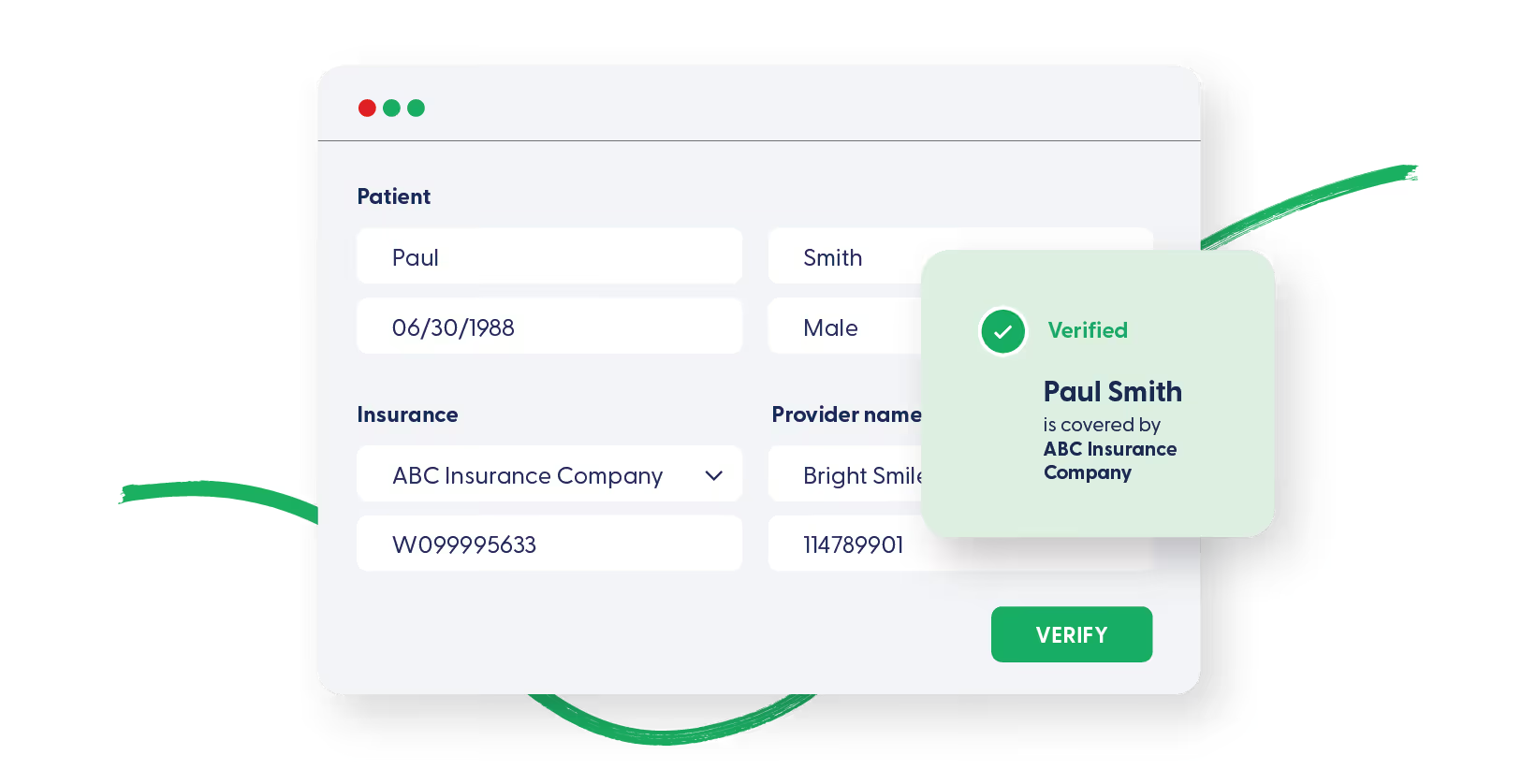
One Platform, Every Financial Touchpoint. DI connects scheduling, treatment planning, insurance verification, patient communications, in-office and online payments, payment plans, claims tracking, and reporting in a single ecosystem. Data flows seamlessly from one stage to the next, eliminating the handoff errors and reconciliation headaches that plague multi-vendor environments.
Integrated Payments Built for Dentistry. DI’s embedded payment processing is designed specifically for dental workflows — not retrofitted from retail or generic healthcare. In-office terminal transactions, online bill pay, automated payment requests via text and email, and flexible patient financing all operate within the same platform, with every transaction automatically reconciled against the patient ledger. Features like compliant surcharging programs enable practices to offset credit card processing fees entirely — turning payments from a cost center into a revenue-neutral operation while maintaining full transparency for patients. The result: faster collections, significantly lower processing costs, and complete financial visibility.
Analytics That Drive Action. DI’s analytics engine doesn’t just report on what happened — it identifies what to do next. Morning Huddle dashboards highlight the day’s revenue opportunities. Practice performance scorecards benchmark locations against peers and best-in-class targets. Automated alerts flag at-risk accounts, overdue balances, and trending denial codes before they become systemic problems.
Scalable for DSOs and Group Practices. For multi-location organizations, DI provides enterprise-level oversight with location-level granularity. Regional and corporate leaders can monitor revenue cycle KPIs across every practice from a single dashboard, identify top and bottom performers, and deploy standardized workflows that ensure consistency and accountability at scale.
Proven Results: What the Data Shows
A before-and-after analysis of 1,355 dental practices measured key performance indicators in the quarters before DI Payments adoption versus the quarters after. The results demonstrate consistent, measurable improvement across the revenue cycle:

Source: DI Payments internal analysis, April 2026. Before/after methodology across practices boarded Jul 2023–Mar 2025. n = 1,197–1,344 per metric.
The headline numbers tell a compelling story. Practices reduced accounts receivable by 10 full days after adoption, freeing roughly $45,000 in working capital per practice. Annual collections increased by approximately $200,000 per practice. And the hygiene reappointment rate — a leading indicator of long-term patient retention and recurring production — jumped 8.7 percentage points, the single strongest improvement across all KPIs measured.
Beyond practice-level performance, DI customers with integrated payments exhibit an 8-percentage-point higher gross retention rate compared to software-only customers, underscoring that payments isn’t just a financial tool, but a retention and engagement asset that strengthens the entire practice relationship.
The Path Forward
Revenue Cycle Management is too critical to leave to chance, and too complex to manage with disconnected point solutions. The practices and DSOs that will lead the next era of dental care are those that embrace a unified, technology-driven approach: one that combines the operational rigor of industry best practices with the intelligence of real-time analytics and the simplicity of a single integrated platform.
Dental Intelligence delivers exactly that. Purpose-built for dentistry, proven across more than 1,300 practices, and continuously innovating — DI transforms the revenue cycle from a source of friction into a driver of growth.
Ready to unify your revenue cycle?
Contact us at dentalintel.com to schedule a consultation.
.avif)
.avif)



.avif)